How cognitive dependence and judgment erosion are reshaping creative work in the age of AI.

TLDR: Beyond job loss, AI is creating a quieter crisis for creative professionals: cognitive dependence, weakened judgment, and the slow erosion of independent thinking.
The conversation around AI typically focuses on one question: Will AI take our jobs?
That's the wrong question. Or at least, it's only half the question.
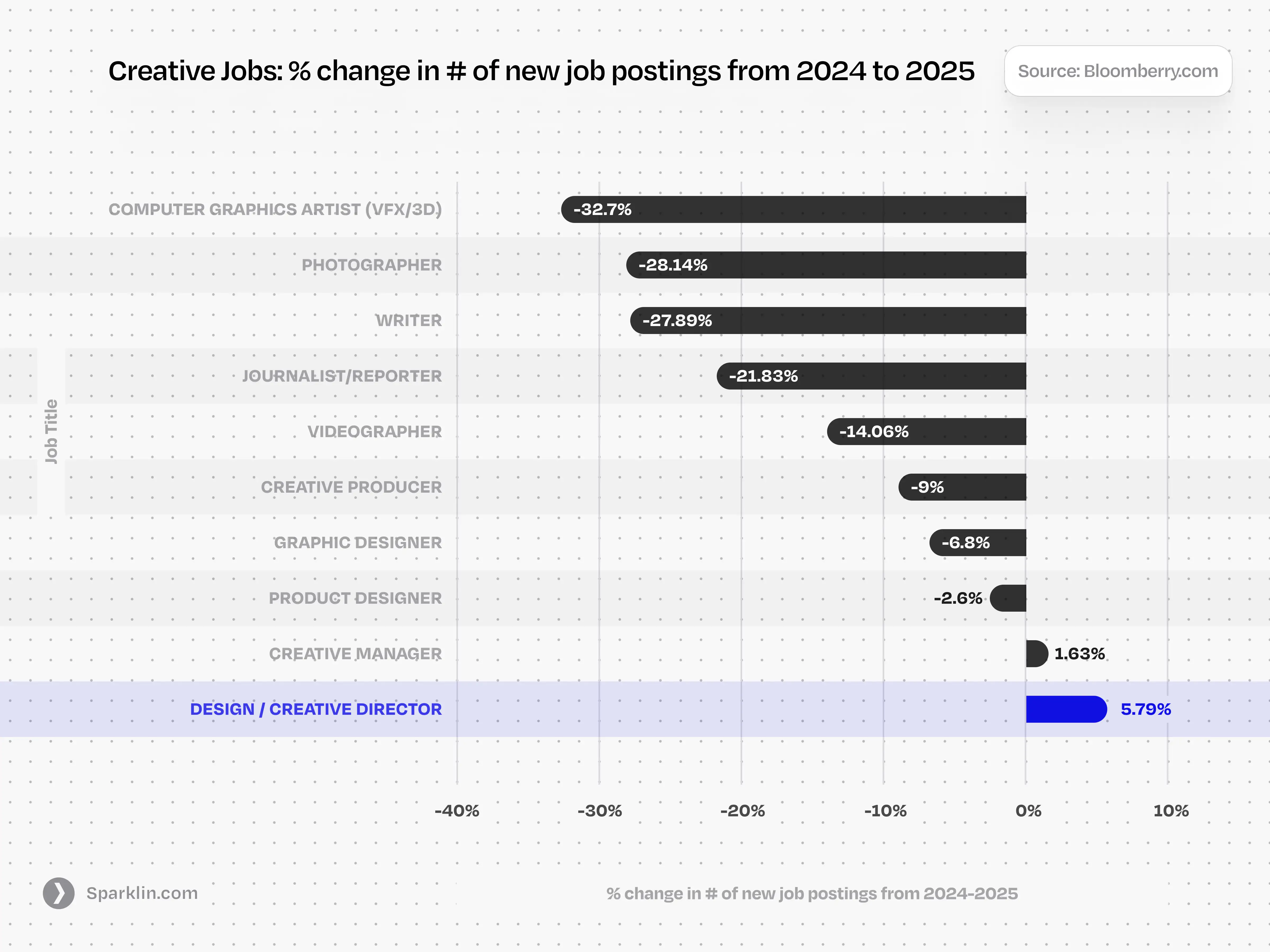
While analysis of 180 million job postings shows computer graphic artists down 33%, photographers down 28%, and writers down 28%, but after spending time speaking with creative professionals across experience levels, I am convinced this is only half the crisis.
The quieter and more troubling shift is happening to people who still have jobs.
Many are producing more than ever, working faster than ever and gradually losing confidence in their ability to think, write, or design without assistance. They're losing the ability to think independently.
Recent studies reveal that professionals using AI tools for extended periods show measurable cognitive decline. A 2025 MIT study found that individuals who consistently rely on AI for writing and decision-making exhibit reduced brain activity, diminished memory retention, and less original thinking. Workers report being unable to complete tasks without AI assistance that they previously handled with ease.
Cognitive dependence on AI refers to the gradual loss of a professional’s ability to think, create, or decide independently after prolonged reliance on AI tools.
This shift deserves careful attention. Creative roles are evolving and so are the ways professionals think and make decisions. As AI becomes more embedded in everyday workflows, there is a growing risk of over-reliance, where judgment, intuition and craft receive less active exercise. AI has already reshaped creative work. What remains open is how creatives adapt; whether these tools strengthen human capability or quietly narrow it over time.
The Execution Jobs Are Disappearing First
The pattern emerging from job market reveals AI is reshaping certain segments of creative work more quickly than others.
Analysis examining millions of job postings shows that execution-focused creative roles are collapsing while strategic positions hold steady or grow. Computer graphic artists, photographers, and writers face steep declines. Meanwhile, creative directors, creative managers, and producers continue hiring at normal or elevated rates.
This split makes sense when you consider what AI actually does well. Tools like Midjourney can generate polished visuals in seconds. ChatGPT can draft serviceable copy faster than any human.
From a distance, this looks like progress. From close up, it looks like the removal of a learning environment.
I recently spoke with a junior designer who applied to over forty roles in three months. She received two interviews. In both cases, the hiring manager mentioned they were exploring AI tools to reduce junior hiring. She eventually found work only after reframing her portfolio around strategic thinking rather than visual execution. Her earlier portfolio was strong. It was not scarce anymore.
Everyone can now generate competent visuals. What is disappearing is the space where people learned how to decide what good actually looks like. Judgment was never formed in isolation. It developed through critique, friction, client reactions, and the quiet calibration that happens inside real meetings.
AI still cannot read a client’s subtle dissatisfaction, sense when an idea is politically unsafe, or make the intuitive leaps that define breakthrough campaigns. Those skills are not technical gaps. They are experiential ones. And experience requires time inside the system.
The longer-term implication extends beyond current job losses. As companies reduce junior roles, they also thin their future talent pipelines. Creative leadership has historically grown through apprenticeship. People learned by watching decisions being made, by making small mistakes, and by gradually being trusted with bigger ones. When entry points disappear, the path to senior craft and judgment becomes harder to sustain.
Harvard Business Review research highlights this short-sighted logic clearly. Replacing entry-level roles with AI creates immediate efficiency while quietly eroding future leadership capacity. CFOs see the cost savings today. The leadership vacuum will only become visible years from now, when there is no one left who knows how to make the call. It is like a sports team deciding to shut down its minor league system to save money. The first season looks fine. The real consequences arrive later, when there is no one ready to step up.
When AI Convenience Turns Into Cognitive Dependence
Alongside job loss, something else is happening that is harder to measure but easier to feel.
Many creative professionals are becoming dependent on AI in ways that go beyond productivity.
Using AI occasionally or thoughtfully is fine and I recommend it. But what really scares me is how we are defaulting to it. Writing begins with a prompt instead of a blank page. Ideation starts with generated options rather than internal exploration. Decisions are validated externally before being formed internally.
A content marketer I know uses ChatGPT throughout the day for everything from campaign ideas to email phrasing. When I asked what happens if she starts without it, she hesitated and said, “I honestly don’t anymore.”
An engineer of mine admitted that while helping his child with long division, his first instinct was to ask an AI tool to explain it.
Think about how GPS changed navigation. Most people under 40 can barely read a paper map anymore. They're not stupid or lazy. They just never needed to develop that skill because Google Maps was always there. Now apply that same dynamic to thinking itself.
Research from MIT documents what's happening physiologically: reduced brain activity, diminished memory retention, less original thinking. But you don't need a brain scan to recognize the problem. Just notice how often you reach for AI before attempting to solve something yourself.
The mechanism is insidious. AI reduces cognitive load in ways that feel immediately rewarding. Facing a challenging creative problem triggers mental discomfort. Consulting AI delivers instant relief. That immediate gratification overrides any long-term concerns about your skills degrading.
I watched this happen to a writer I mentored. She started using AI for brainstorming, which seemed reasonable. Then for first drafts. Then for editing. Within six months, she couldn't write a straightforward blog post without ChatGPT's help.
And unlike GPS navigation, where the worst-case scenario is getting lost on the way to a restaurant, cognitive atrophy directly threatens your professional value. If you can't write, think, or create independently, what exactly are you bringing to your role?
The AI Business Model Wants You Hooked
Let's be clear about the incentives at play. AI companies profit from your dependence. The more indispensable their tools become to your daily workflow, the more money they make. It’s a business at the end.
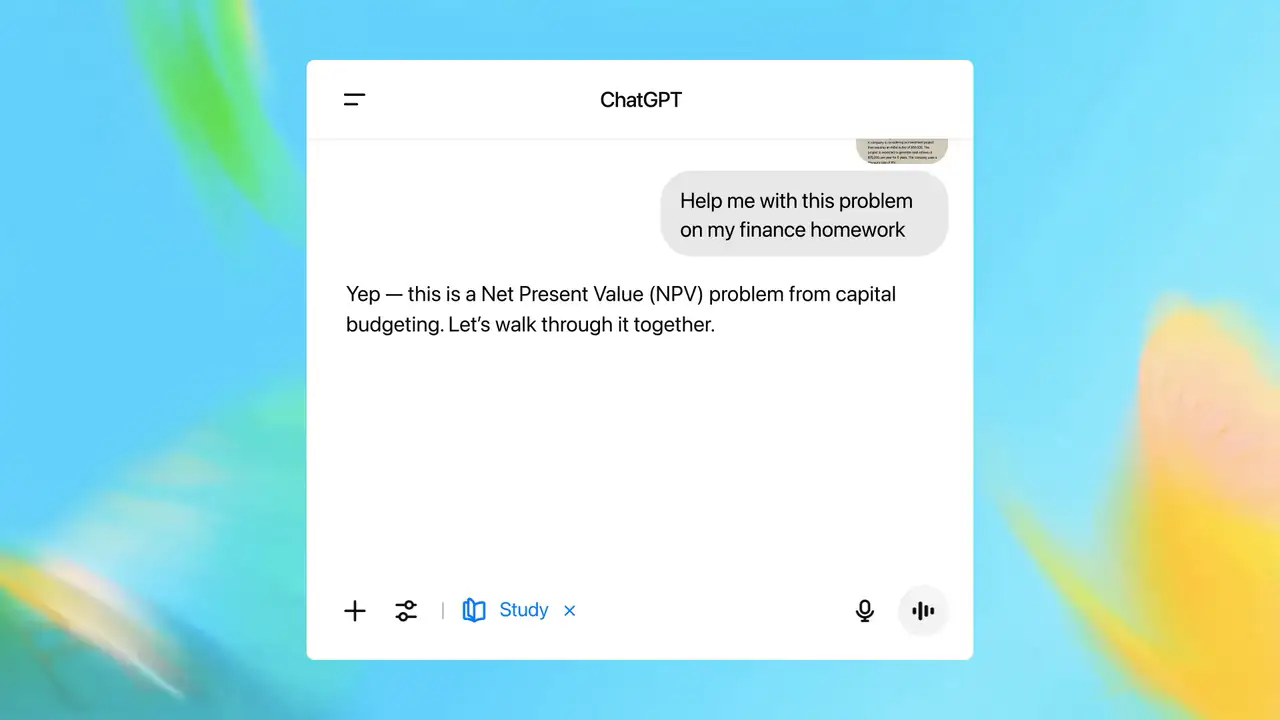
OpenAI introduced "study mode" supposedly to discourage outsourcing your thinking. But notice the tension there. They need you to use their product constantly while also maintaining the fiction that you're still in control. It's like a casino offering "responsible gambling" pamphlets while pumping oxygen into the room and removing all the clocks.
AI companies win when you can't imagine working without their product.
Younger workers feel this pressure most acutely. If you're 23 and entering a creative field, you've heard nothing but doom about AI taking your job. Workers aged 18-24 are 129% more likely than those over 65 to fear AI displacement. So what do they do? They become power users of the very technology they fear, trying to stay ahead of the automation wave.
The paradox creates a self-fulfilling prophecy. The more you rely on AI to remain competitive, the less you develop the independent capabilities that actually differentiate you from AI outputs. You're running faster and faster on a treadmill that's accelerating beneath you.
A 24-year-old graphic designer told me she uses Midjourney for every project because "that's what the market expects now." When I asked if she could still design without it, she hesitated. "Probably? But why would I? It would take ten times longer and look worse." She's probably right. But she's also eliminating the only thing that could make her irreplaceable: her unique creative vision developed through practice.
The AI Efficiency Trap for Creative Professionals
Yes, AI makes you faster. Adobe surveys show 62% of creative professionals reduce task completion time by about 20%. That's one full workday saved per week. Workers report feeling more creative (84%) and enjoying their work more (83%).
But speed and efficiency aren't the same as capability. You can use AI to generate ten concept variations in minutes, but if you can't independently evaluate which one actually solves the problem, you're not more capable. You're just faster at producing options you can't assess.
The struggles we're outsourcing to AI are often the parts that make us better at our jobs. Working through a creative block builds problem-solving muscles. The frustration of finding the right word develops your instinct for language. The serendipity of unexpected mental connections comes from your brain making its own associations, not from AI serving up pre-packaged ideas.
AI reduces cognitive friction, and friction has long been treated as something to eliminate. Creative blocks are uncomfortable. Uncertainty is frustrating. AI offers immediate relief.
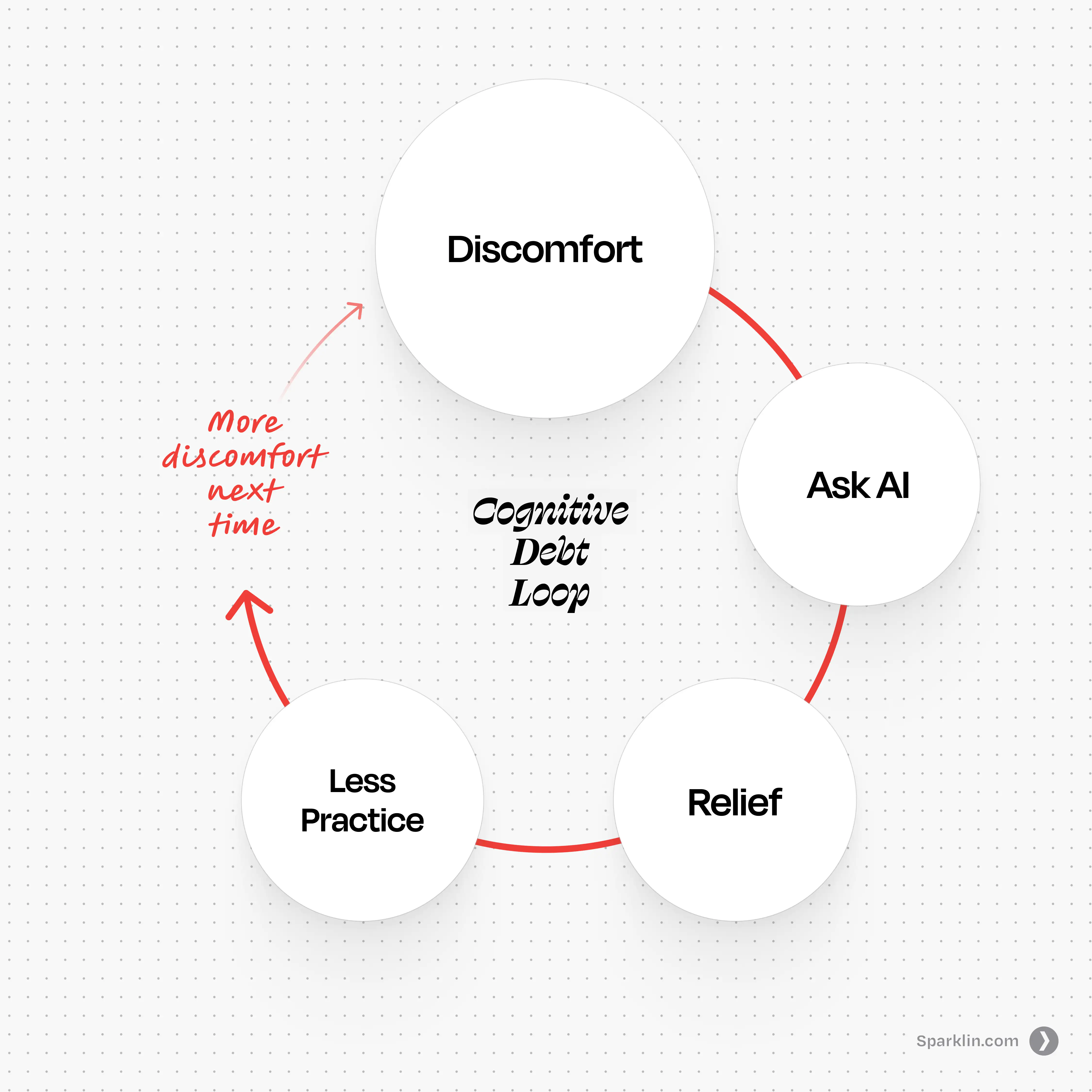
The problem is not relief itself. It is a sequence.
When AI becomes the first step rather than a later one, people skip the mental work that produces insight. Over time, generation turns into evaluation. Editing replaces originating.
When you delegate first-draft generation to AI, you skip the messy thinking that produces genuine insights. You get clean outputs faster, but you're not developing the creative instincts that separate good work from mediocre work. The polish improves while the thinking atrophies.

I see this constantly in creative work now. Everything looks professional. Everything is technically competent. And almost nothing is genuinely surprising or insightful. We're producing more work faster, but the work itself has become homogeneous. When everyone's using the same AI tools with similar prompts, the outputs converge toward a slick, soulless middle.
Some professionals maintain healthy boundaries. They use AI for genuinely tedious tasks like formatting or initial research while reserving judgment and creative decisions for themselves. They might generate ten AI concepts but insist on making the final selection independently. They ask AI for approach suggestions but work through solutions on their own.
The difference is whether you're directing the AI tool or the AI tool is directing you.
What Actually Protects Your Career From AI
If execution work is disappearing and cognitive capabilities are eroding, what actually makes you valuable?
The answer keeps coming back to the same things: judgment, emotional intelligence, strategic thinking, and genuine creative vision. They're the concrete capabilities that AI genuinely cannot replicate.
AI can generate a dozen logo concepts, but it can't read the room when a client says they love your work while their body language screams dissatisfaction. It can write decent copy but can't navigate the political dynamics of getting that copy approved through three layers of stakeholders. It can analyze data but can't make the intuitive leap that connects disparate ideas into breakthrough campaigns.
I watched a senior creative director at Sparklin navigate a nightmare client situation last month. The client kept rejecting concepts without articulating why. An AI could generate infinite variations, but it took human intuition to recognize the client was politically trapped between their own vision and their CEO's contradictory demands. The creative director solved it by creating a presentation that let the client save face while getting what they actually needed. No AI prompt could have navigated that.
Analysis of AI-resistant careers consistently points to roles requiring complex human judgment and creative vision as the most secure. The market increasingly demands professionals who can bridge technology and creativity. AI Engineer positions grew 143%, while AI Content Creator roles jumped 135%. Notably, design skills now surpass technical coding abilities as the most sought-after competency.
This suggests the market is evolving toward AI-human collaboration rather than pure replacement. But collaboration requires you to bring something distinct to the partnership. If your contribution is just "person who prompts the AI," you're not particularly valuable. If your contribution is "person with developed judgment who leverages AI for appropriate tasks," you're indispensable.
Watching how teams adapt to AI reveals an interesting divide.
Some professionals treat AI as a replacement. Others treat it as a threat. The ones who seem to benefit most fall somewhere else entirely. They developed strong independent capabilities first and then learned to extend those capabilities with AI. They know what good work looks like because they have made it themselves. That experience allows them to judge, not just generate.

 Hide reactions